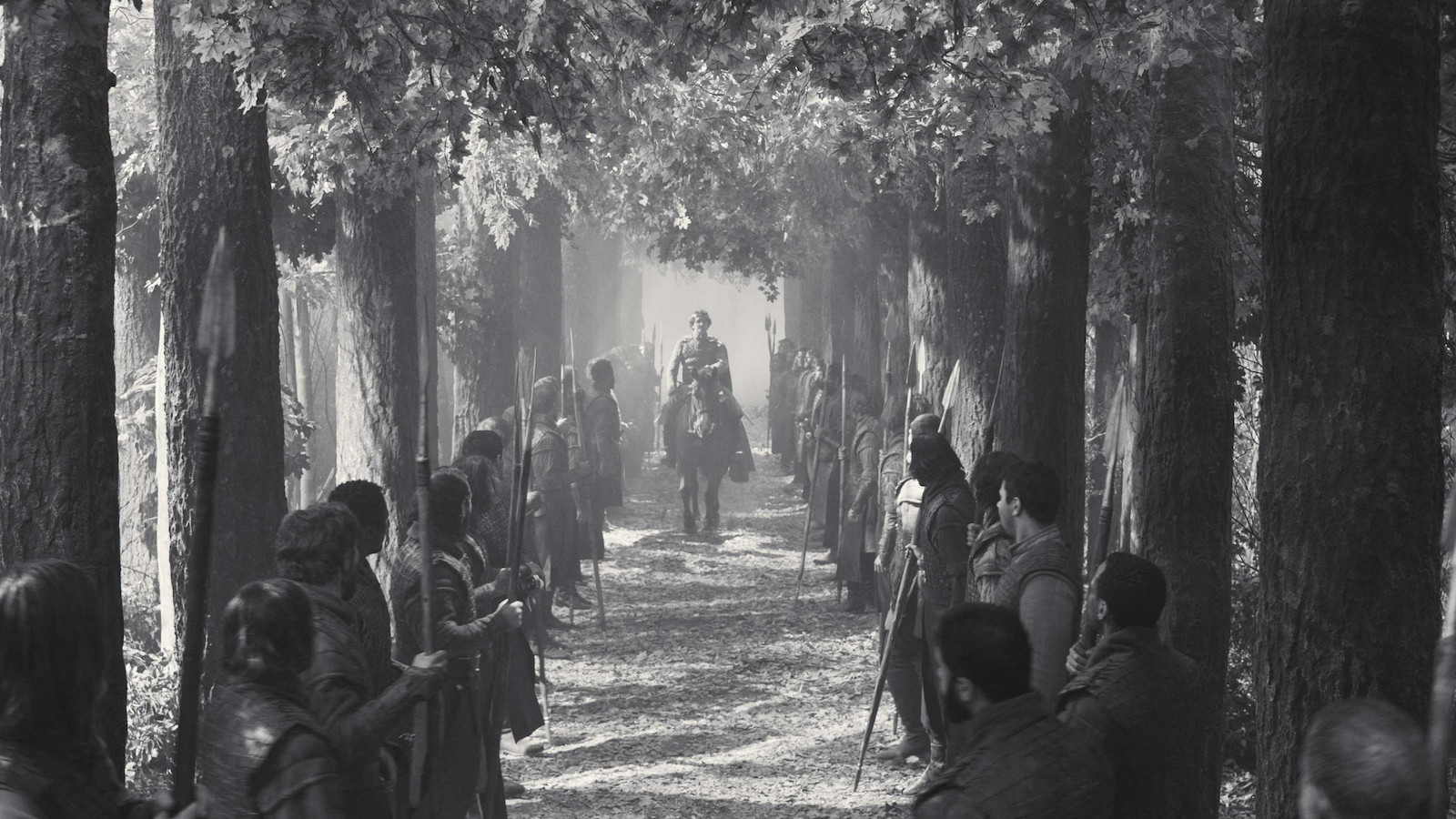
Sculpting in time
“Life’s but a walking shadow, a poor player,
That struts and frets his hour upon the stage,
And then is heard no more. It is a tale
Told by an idiot, full of sound and fury,
Signifying nothing.”
WHEN JOEL COEN (born 1954) released The Tragedy of Macbeth (2021), it was his first film produced without his brother, Ethan—a singular act mirrored perhaps by the inward solitude of this stunning and spellbinding feature. What emerged is stripped to its bare essence: black and white, sculptural, almost ungeographic. There is no Scotland, no history, no external world—only the theatre of the mind itself. In that stark reduction, William Shakespeare’s darkest play thus becomes a meditation on the human condition at its very core.
Every corridor is a thought, every shadow an idea manifesting into dramatic configuration. The characters are not people so much as emanations of a single sentience, momentarily divided against itself. Seen through a nondual lens, tragedy dissolves into metaphysics—not the fall of a man but illusion folding back upon itself, similar to an Escher lithograph.
Indeed, by withholding colour, time and placement, Coen exposes the structure of consciousness per se. What we witness, therefore, is not moral corruption and hubris but the drama of separation, awareness watching itself become what it is ultimately not.
“Nothing is, but what is not.”
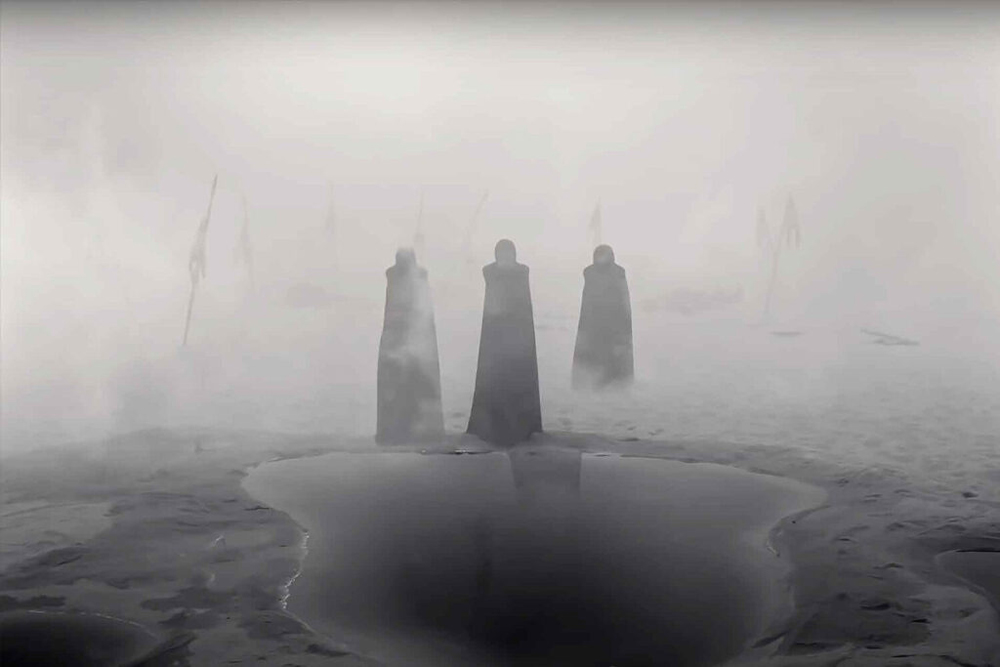
Macbeth’s realization, deftly played by Denzel Washington, that “nothing is, but what is not”, defines the film’s entire world whereby reality is projected into a mirage of desire, fear and trembling. The witches, fluid and ambiguous, arise not from the heath but within the thane’s own inner conscience: energies of ambition and dread coalescing into a terrifying voice. Kathryn Hunter’s magnificent triple-bodied witch embodies this reality—one consciousness seen in three reflections, setting the ominous tone for designer Stefan Dechant’s exquiste mise en scènes to follow.
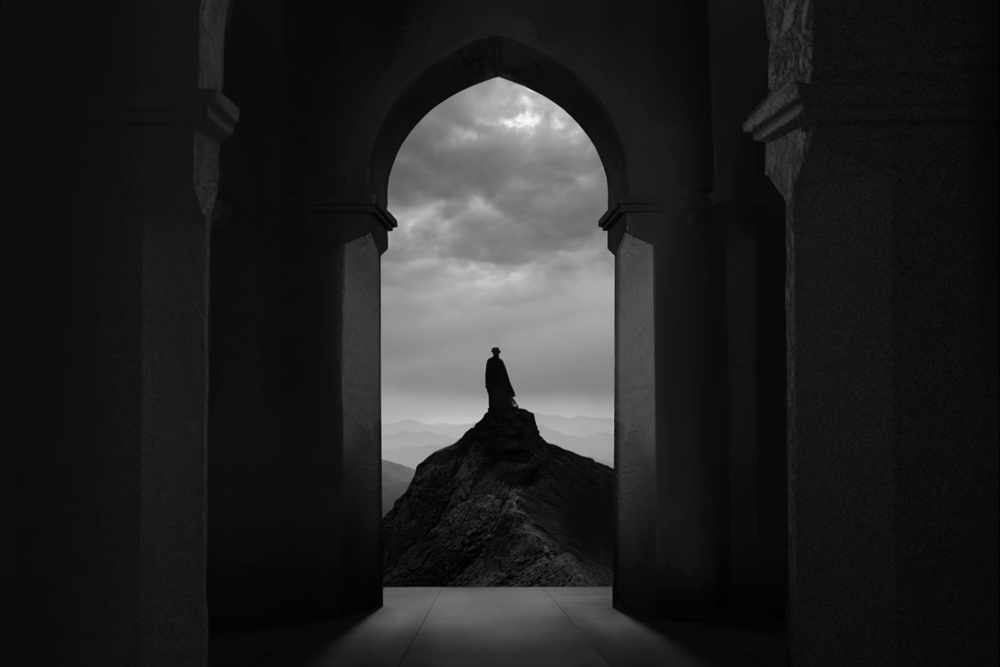
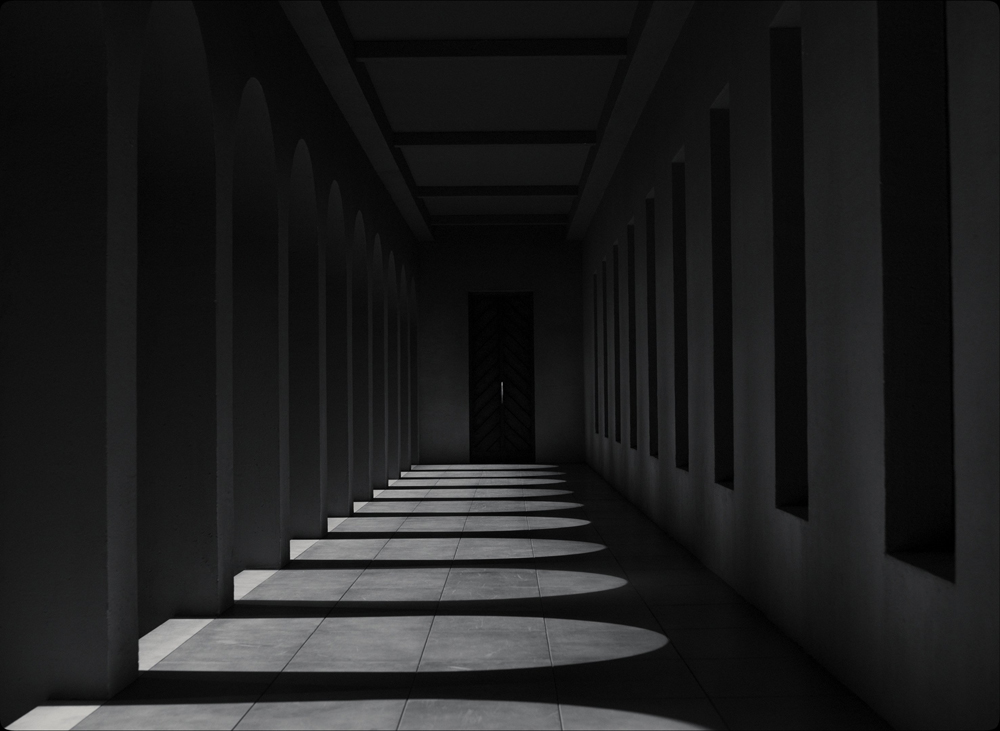
Indeed, the arresting architectural motif heightens this sense of dreaming. Walls rise and vanish like thoughts; doorways open into an empty void. Coen’s visual language reminds us of other auteurs’ oneiric use of the aesthetic and dependence on optical appearance: Carl Theodor Dreyer’s undulating landscapes in Ordet; Fritz Lang’s geometric precision in Metropolis; Ingmar Bergman’s exacting costumery in The Seventh Seal.
This creative use of ocular metaphor is embodied in the iconic vision of the floating dagger, which cleverly shapeshifts into a door handle in Coen’s masterpiece, emphasizing how desire takes on physical form and illusion becomes tangible reality. Specifically, it is the ego’s dialectic, grasping at its own reflection, that mistakes imagination for objectivity. In nondual terms, this is the primal error—awareness identifying with its projection and then suffering eternally on its own behalf.
© Joel Coen, The Tragedy of Macbeth
“By the pricking of my thumbs,
something wicked this way comes.”
Macbeth’s vaulting ambition is not merely political but ontological: it is the desire to shape destiny itself. Lady Macbeth, superbly played by Frances McDormand, urging him ever onwards, becomes the personification of shakti, the energy of manifestation and the physical realm. Together they form the eternal polarity of masculine and feminine, stillness and motion, intellect and body, propelling consciousness into form.
And yet once the egoic persona arises, it casts a darkly shadow over events. Karma, memory and guilt emerge as consequences of a perceived disconnect, binding Macbeth further to illusion and the wheel of his irrevocable demise. Coen’s claustrophobic interiors make this catastrophic state of affairs quite literal: the palace is the mind, both self-enclosed and echoing, with the newly appointed king pacing like thought itself, trapped in the corridors of its own invention, akin to the infamous mansion in Alain Resnais’ Last Year at Marienbad.
Their tumultuous union burns, then collapses as it inevitably must. Lady Macbeth’s remorse speaks to the futility of action born in ignorance—what is done in delusion cannot be undone. Their downfall is not personal but universal, representing the exhaustion of ego’s attempt to rule in an illusionary world.
© Joel Coen, The Tragedy of Macbeth
“Out, out, brief candle!
Life’s but a walking shadow …”
After Duncan’s death, Macbeth enters the world between waking and dreaming, a twilight zone of lucid terror. He has “murdered sleep”, the symbol of undivided awareness and in its place comes a state of restlessness—the ego’s vigil over its own fragmented self. Indeed, his insomnia mirrors our collective conditioning: a civilization unable to rest in being, forever propelled by the desire to act for selfish means.
Lady Macbeth’s sleepwalking, filmed in spectral chiaroscuro, reveals a similar longing for purification. Her compulsive gestures of washing and erasure enact the futile search to cleanse the doer of their heinous deed. What she seeks to remove is the veil of separation, the stain of duality. And yet it cannot be disinfected; it must be seen through and transcended if closure be the final goal.
Macbeth’s fleeting sense that life unfolds of its own accord offers a glimpse of awakening. To see that events arise by themselves is to touch the freedom he seeks but fear recoils from surrendering to such profound truth. Thus, the insight curdles into control and is cemented into individual destiny, the shadowy dream solidifying itself once more.
© Joel Coen, The Tragedy of Macbeth
“What’s done cannot be undone.”
As battle closes in, Macbeth’s language slows to insignificance. Life becomes a flickering candle, a walking shadow, a performance disintegrating into the silence of the abyss.
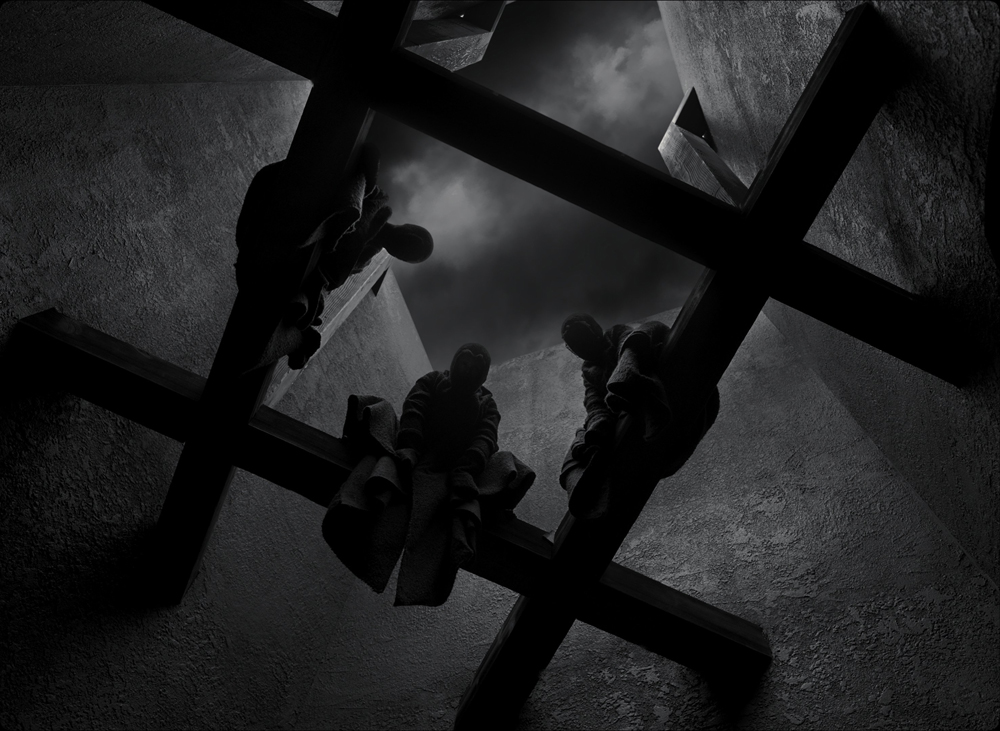
Weary of the sun, Macbeth finally abandons all striving. The light of action fades into stillness. Coen renders this surrender with ritual clarity: his gestures already half-absent, violence is transformed into mere ceremony as befitting a fallen king. The end feels neither despairing nor defiant but inevitable—an unwinding back into the unborn self.
In that exhaustion lies release. The ego collapses under its own weight and what remains is presence itself. The tragedy concludes before the final blow, resolved in deathly silence—the liberation that arises when illusion has run its course.
© Joel Coen, The Tragedy of Macbeth
“I ‘gin to be aweary of the sun.”
After Macbeth’s passing, Coen withholds restoration for his characters. There is no moral resolution, only empty space and barren wind. What seemed violent and fated now appears to be cyclical in nature: consciousness entering form, forgetting and then returning to its source.
In that recognition, the act of sin becomes misidentification. The witches, the crowns, the murders are all movements of the same stuff that dreams are made of, rounded with the sleep of death. To cease moralizing is to see completion. Catharsis lies not in punishment but in the understanding that things are as they are.
By stripping away the world, Coen brings us to the brink of the void where form and emptiness are in collision. In those hollow halls and vacant cloisters, we sense the still point Shakespeare intuited and nondual philosophy gives its labels to—the quiet realization that there was never anything to forgive, nothing to attain and, ultimately, nowhere to go.
Post Notes
- Feature image: © Joel Coen, The Tragedy of Macbeth
- Shūsaku Endō: Silence
- Kaneto Shindo: The Naked Island
- Robert Harris: Conclave
- Paolo Sorrentino: The Great Beauty
- Pavel Lungin: The Island
- Abbas Kiarostami: 24 Frames
- Alain Resnais: Last Year at Marienbad
- Jean Cocteau: The Art of Cinema
- Andrei Tarkovsky: Cinematic Genius
- Nuri Bilge Ceylan: Once Upon a Time in Anatolia
- Sergei Parajanov: The Colour of Pomegranates
- Ben Rivers: Two Years at Sea
- Michelangelo Frammartino: Le Quattro Volte
- Bill Viola & Michelangelo: Life Death Rebirth
- Abbas Kiarostami: Certified Copy
- The Culturium uses affiliate marketing links via the Amazon Associates Programme