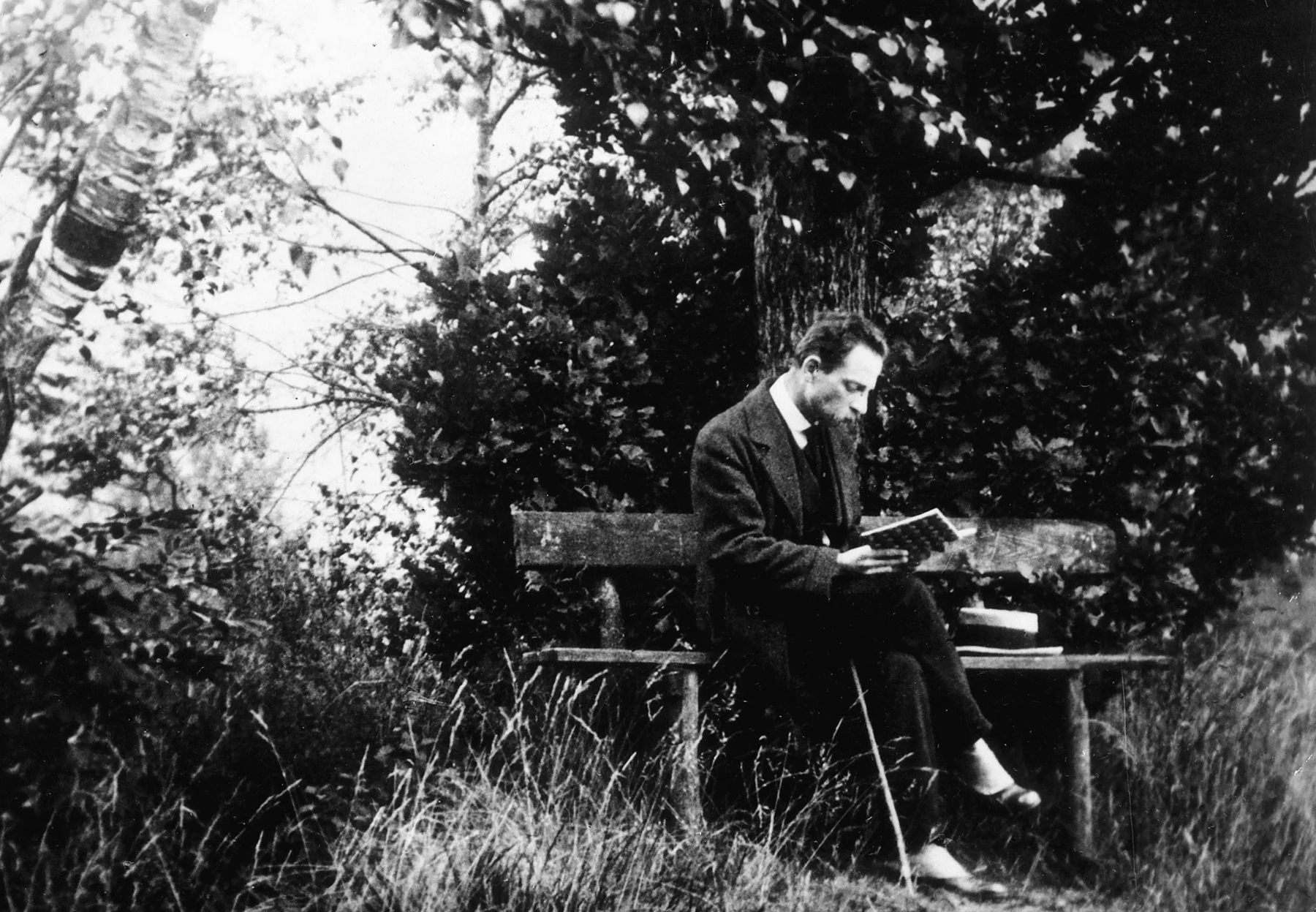
Ode to silence
“That solitude in which I have anchored myself for twenty years …
must be the fundamental consciousness I can always return to,
not expecting it to be fruitful, but arriving there involuntarily,
unstressed, innocently: like the place where I truly belong.”
—Rainer Maria Rilke, “The Testament”
THE WORK OF Rainer Maria Rilke (4th December 1875–29th December 1926) has often been featured on The Culturium and needs little introduction to anyone interested in spirituality and the creative arts. Suffice to say, he stands among the most luminous figures of 20th-century European literature, whose writings search tirelessly for the ineffable, with his celebrated Letters to a Young Poet (1929) remaining a touchstone for artists and seekers alike.
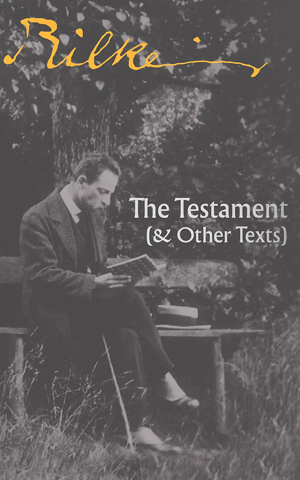
Imagine my joy and gratitude when Contra Mundum Press made contact to share details of the forthcoming world premiere of the English translation of Rilke’s The Testament (a text I must confess I had never even heard of before), to be published on 4th December 2025, in honour of the 150th anniversary of Rilke’s birth. Deftly translated and introduced by Mark Kanak and edited by Rainer J. Hanshe, it has been a rare treat to be so drawn in by the beauty and wisdom of Rilke’s literary sensibility and his examination of whether or not an artist may remain true to his calling even when the afflatus has passed.
Opening with the outbreak of WWI, a devastating world event that prevents the poet from returning to the “incomparable city of Paris”, Rilke is entwined with his own debilitating crises—vagabondage and poverty as well as an impasse with writing the Duino Elegies—and is thus at a decisive juncture of his career. As a consequence, during the week of 24th–30th April 1921, he undergoes a self-imposed auto-da-fé or ritualized penance in order to articulate what his life and work have been about until this crucial moment. The short tract becomes, therefore, a metaphysical will and testament summing up his failures and accomplishments as a poet in every sense of the word.
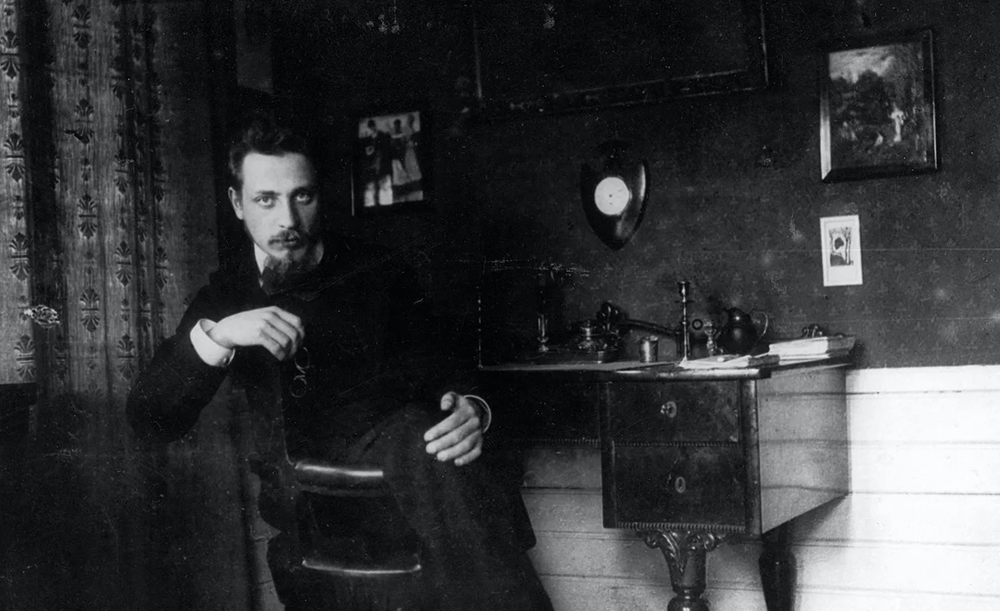
Rainer Maria Rilke
Composed of journal passages, lyrical “draft letters” and poetical, wistful prose, these fragmentary writings address the artist’s inner struggles with work, life and love, tested in the crucible of solitude and the sinister expanse of an ominous blank page. In the follow passage, Rilke asks whether a true artist can remain inwardly aligned, steady and receptive even when the creative muse has left him, with personal inspiration and momentum utterly unable to help:
Do not fool yourself, artist, into thinking that your proof lives solely in your work. You are not your persona, nor what others may assume you are out of ignorance, until this guise becomes so ingrained that it feels like second nature and you cannot do otherwise but exist within it. In this way, as you labour, you become the spear cast with mastery: laws take hold of you from the archer‘s hand and drive you into the mark. —What could be more certain than your trajectory?
But the real test, the real proof, is found in the times when you are not cast. When the archer, solitude, has long abandoned you, she forgets you. This is the moment of temptation, the moment of doubt, when you feel powerless, unfit. (As if remaining prepared weren’t challenging enough!) Then, as you rest lightly, distractions take hold and seek other outlets—becoming a blind man’s cane, a bar in a lattice, or a tightrope walker’s balancing pole. Or they root you in the soil of fate, so that the miracle of seasons might unfold within you, and you might sprout green leaves of joy …
So, bold one: rest heavily.
Be a spear. Be a spear. Be a spear!
—Rainer Maria Rilke, The Testament (& Other Texts)
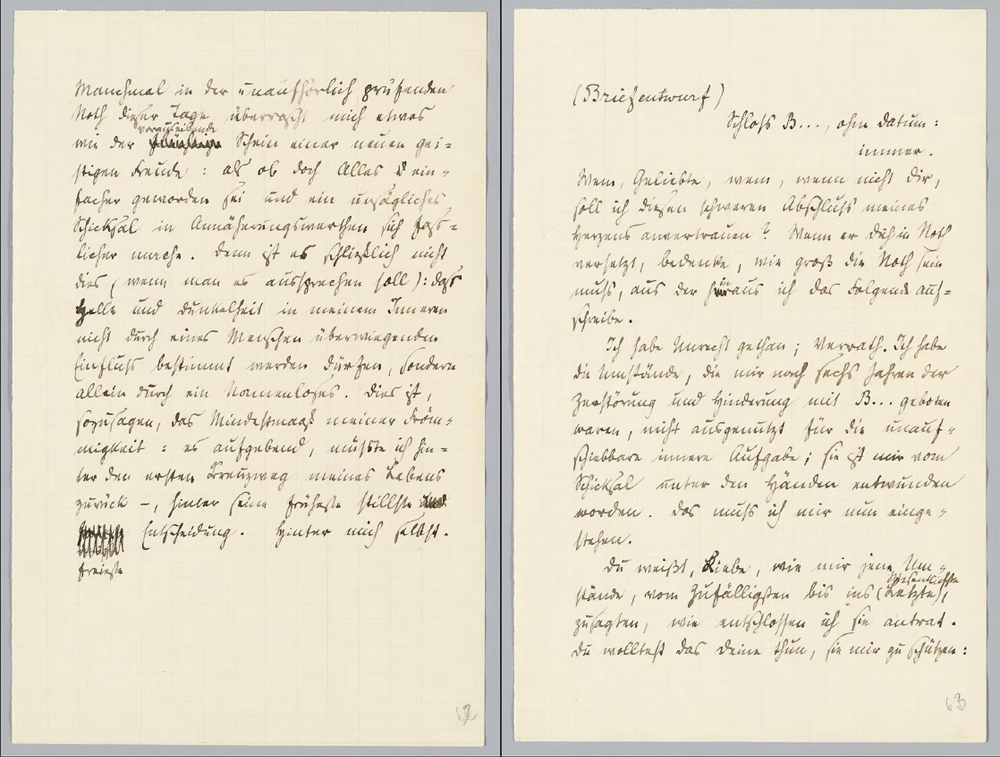
Rainer Maria Rilke, The Testament
Facsimile of Rilke’s text.
At its core, The Testament is an ars poetica for the creative life, whereby the writer’s noble and ultimate task is to serve the invisible, his work therefore embodying a revelation of the words of the divine. Indeed, Rilke believed that poetry was a form of listening, mediated by love in the silence, and in the following extract, he lucidly recounts how a water fountain becomes the transformational voice of the higher Self:
Speak, I said to the fountain, & listened. Speak, I said, and my whole being obeyed. Speak, you pure meeting of lightness and weight, you, the tree of games, you, a parable among the heavy trees of fatigue that fester within its cortex.
And with an involuntary & innocent cunning of my heart, so that nothing would be but this, from which I wanted to learn to be,—I equated the fountain with the Beloved, the distant, restrained, silent one.
Ah, we had agreed that silence should reign between us: it would be the law of this winter, a harsh, implacable law—but now our tenderness was beginning, & not only ours; the weariness of what had been achieved would dwell in my heart. Perhaps—the necessity was so immense—we would be strong enough to keep silent,—but we would not have broken it; the mouth of fate opened & showered us with tidings. For love is the true climate of destiny; as far as it stretches its orbit through the heavens, its Milky Way of billions of stars of blood, the country beneath these heavens lies pregnant with calamities. Not even the gods, in the transformations of their passions, were powerful enough to free the earthly Beloved, the frightened and fleeing one, from the entanglements of this fertile soil.
—Rainer Maria Rilke, The Testament (& Other Texts)
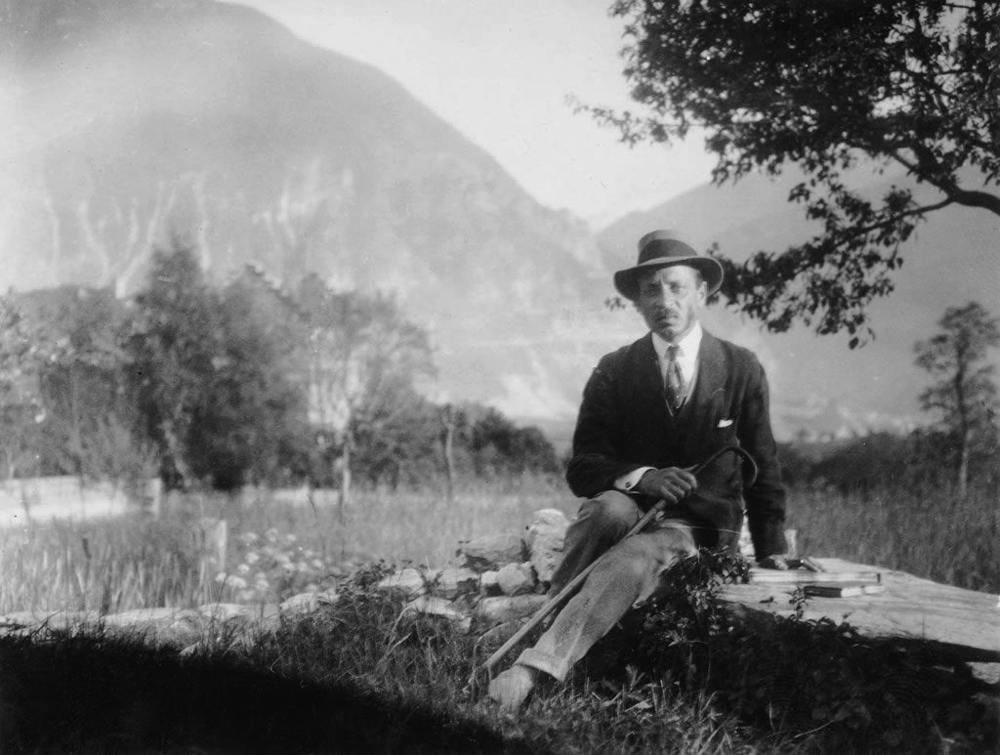
Rilke sitting near the chapel of Muzot, 1924
Image: Swiss Literary Archives, ALS, Berne.
Included within this exquisite volume are essays on politics, the primal sound, the complete poem sequence “From the Literary Estate of Count C.W.” and “Letter to a Young Worker”, which completes the triptych of those to a Young Poet and a Young Painter, serving as a creative interregnum to his final masterwork, The Sonnets to Orpheus. What an absolute pleasure it is to read the formerly unbeknownst work of a superlative writer and give heartfelt thanks to the publishers for bringing this magnificent text to light.
Sometimes, amid the despair that relentlessly challenges me these days, I am surprised by something like the faint early glow of a renewed spiritual joy: as if, in truth, everything had become clearer and an inevitable fate was roughly apprehended. Isn’t the essence of it (if I must express it so): that within my deepest self, light & darkness are not determined by the dominant influence of any person, but solely by something nameless. This, one might say, is the bare minimum of my piety: through renunciation, I should find my way back beyond the first crossroads of my life—, beyond its earliest, quietest, freest decision. Beyond myself.
—Rainer Maria Rilke, The Testament (& Other Texts)
Post Notes
- Feature image: Unknown, Rainer Maria Rilke
- Contra Mundum Press
- Rainer Maria Rilke: Letters to a Young Painter
- Rainer Maria Rilke: Letters to a Young Poet
- Rainer Maria Rilke: On Solitude
- Michel de Montaigne: On Solitude
- Jean-Jacques Rousseau: Meditations of a Solitary Walker
- Philip Gröning: Into Great Silence
- Xavier Beauvois: Of Gods and Men
- Shūsaku Endō: Silence
- Ajahn Sumedho: The Sound of Silence
- John Zerzan: Silence
- The Culturium uses affiliate marketing links via the Amazon Associates Programme