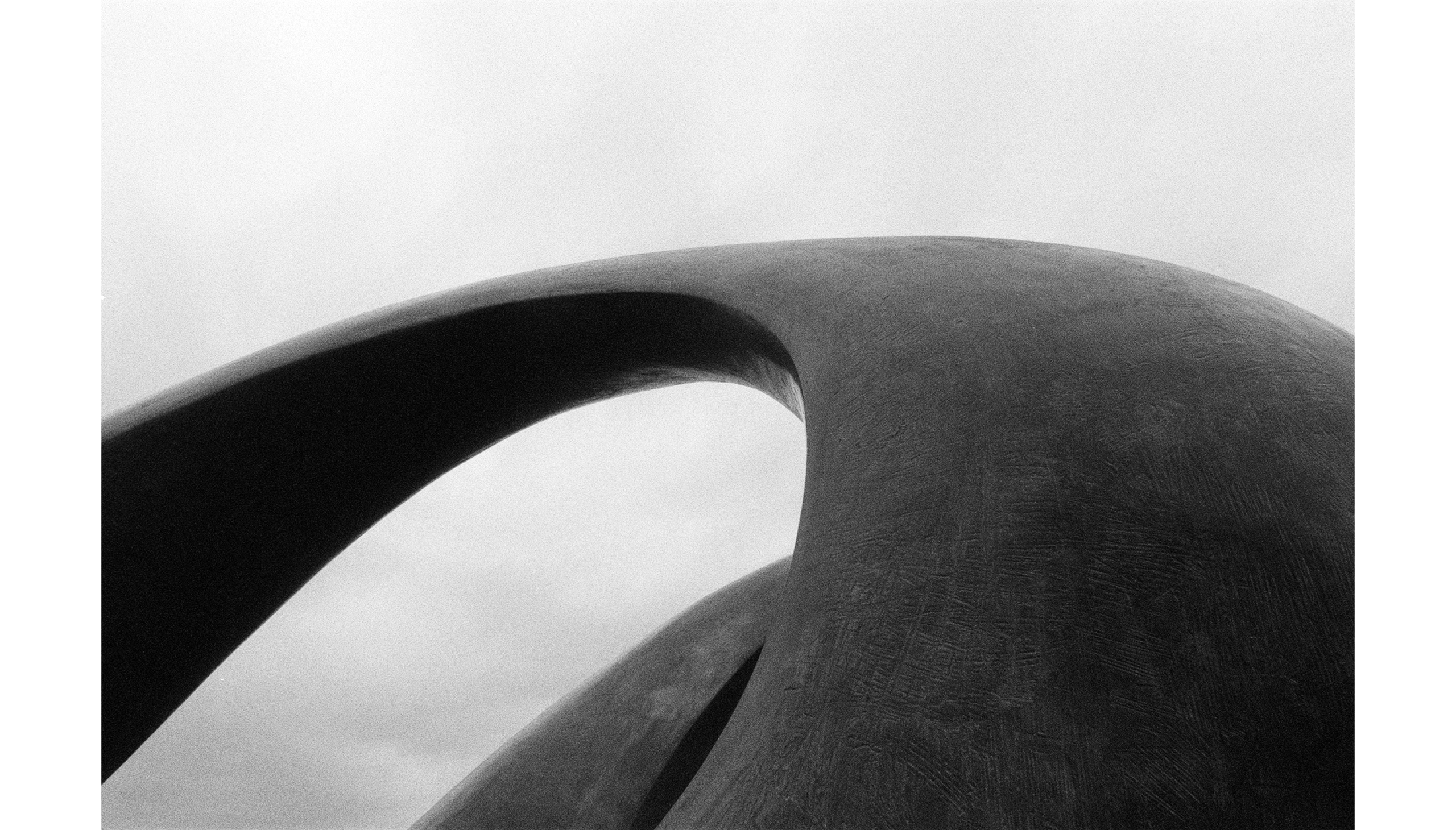
The sculptor speaks
Hoglands
It is a mistake for a sculptor or a painter to speak or write very often about his job. It releases tension needed for his work. By trying to express his aims with rounded-off logical exactness, he can easily become a theorist whose actual work is only a caged-in exposition of conceptions evolved in terms of logic and words.
But though the non-logical, instinctive, subconscious part of the mind must play its part in his work, he also has a conscious mind which is not in-active. The artist works with a concentration of his whole personality, and the conscious part of it resolves conflicts, organizes memories, and prevents him from trying to walk in two directions at the same time.
It is likely, then, that a sculptor can give, from his own conscious experience, clues which will help others in their approach to sculpture, and this article tries to do this, and no more. It is not a general survey of sculpture, or of my own development, but a few notes on some of the problems that have concerned me from time to time.
—Henry Moore, ‘The Sculptor Speaks’, Listener, August 1937
I MUST CONFESS, ordinarily, I am rather averse to most modern art, with its irreverent anti-establishmentarianism and the like, but a trip to Henry Moore’s Studios and Gardens was an eye-opening surprise. Being rather wary of Formalism, a theory that insists the value and meaning of an artwork lie entirely in its visual properties—like colour, line, shape and composition—rather than its subject matter or the artist’s biography, I came away feeling there is something inherently profound in perceiving a piece of sculpture for what it simply is.
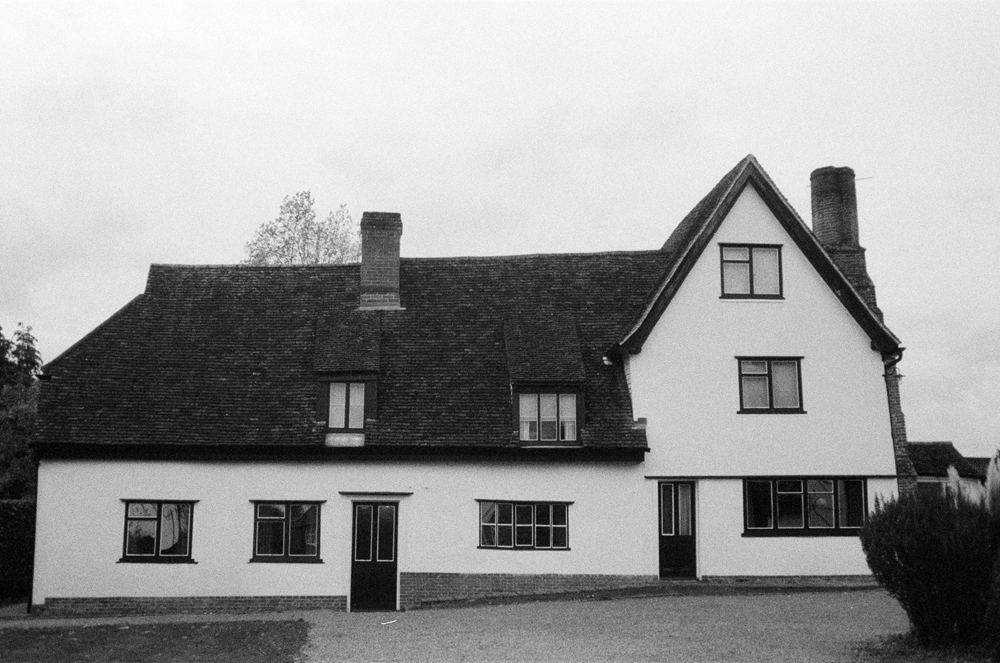
Yorkshire-born British sculptor, Henry Moore (30th July 1898–31st August 1986), is one of the most important and influential artists of the 20th century. From 1940 until his death, Moore lived and worked in the small hamlet of Perry Green, Hertfordshire, where he acquired over 70 acres of land and set up various studios, creating the perfect place to make and showcase his sculpture, culminating in the establishment of the Henry Moore Foundation in 1977.
Although Moore’s work has travelled across the globe adorning civic squares, schools and even housing estates, he knew that it was at his home, Hoglands, that the most intense understanding of his artistry could be appreciated by its diverse and ever-increasing multitude of international dealers and visitors, including friends and fellow artists, film stars, politicians and even presidents, who collectively created a dynamic atmosphere of cultural curiosity, intellectual interaction and creative exchange. My own humble visit confirmed as much.
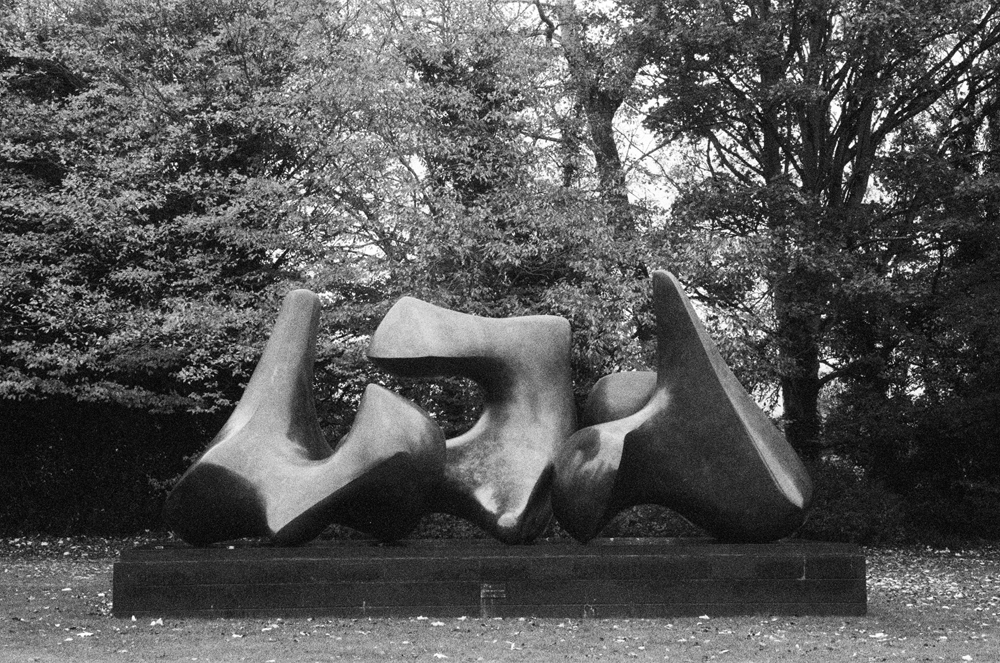
Wanting to escape their Hampstead studio during the horrors of the Blitz, despite his regular night-time visits to the London underground stations producing over three hundred spectacular drawings of huddled men and women sheltering from the air raids, Moore and his wife, Irina, found Hoglands by chance when visiting friends in the neighbouring Hertfordshire village of Much Hadham. Initially, they rented one half of the house, sharing the kitchen and bathroom with the resident farmer’s family, but when the house went up for sale a year later, they bought and reunited the entire property, paying for the hefty £300 deposit from a recent sale of Moore’s work.
As behoves any profound artist, Hoglands provided a peaceful sanctuary, not only away from the bombs dropping all over London but also as a place to reflect and develop his work. Indeed, over time, when Moore had acquired the additional land, he also added a large sitting room extension and converted various outbuildings into bespoke ateliers (Top Studio, Etching Studio, Summer House, Bourne Maquette Studio, Yellow Brock Studio, Plastic Studio and Aisled Barn) to service the specific needs of his practice, as well as house his burgeoning portfolio, including sculpture, drawings, paintings, tapestries, photographic prints, maquettes (preliminary models), as well as a sizeable collection of meaningful objects comprising seashells, pebbles, bones, driftwood, household utensils and anything else that caught his eye.
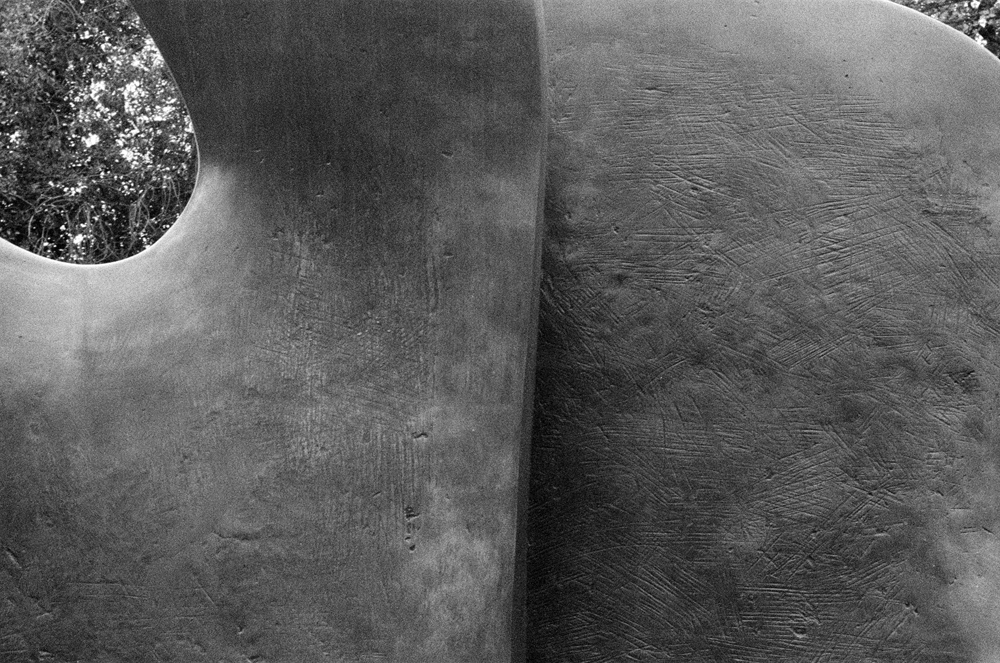
When first working direct in a hard and brittle material like stone, the lack of experience and great respect for the material, the fear of ill-treating it, too often results in relief surface carving, with no sculptural power.
But with more experience the completed work in stone can be kept within the limitations of its material, that is, not be weakened beyond its natural constructive build, and yet be turned from an inert mass into a composition which has a full form existence, with masses of varied sizes and sections working together in spatial relationship.
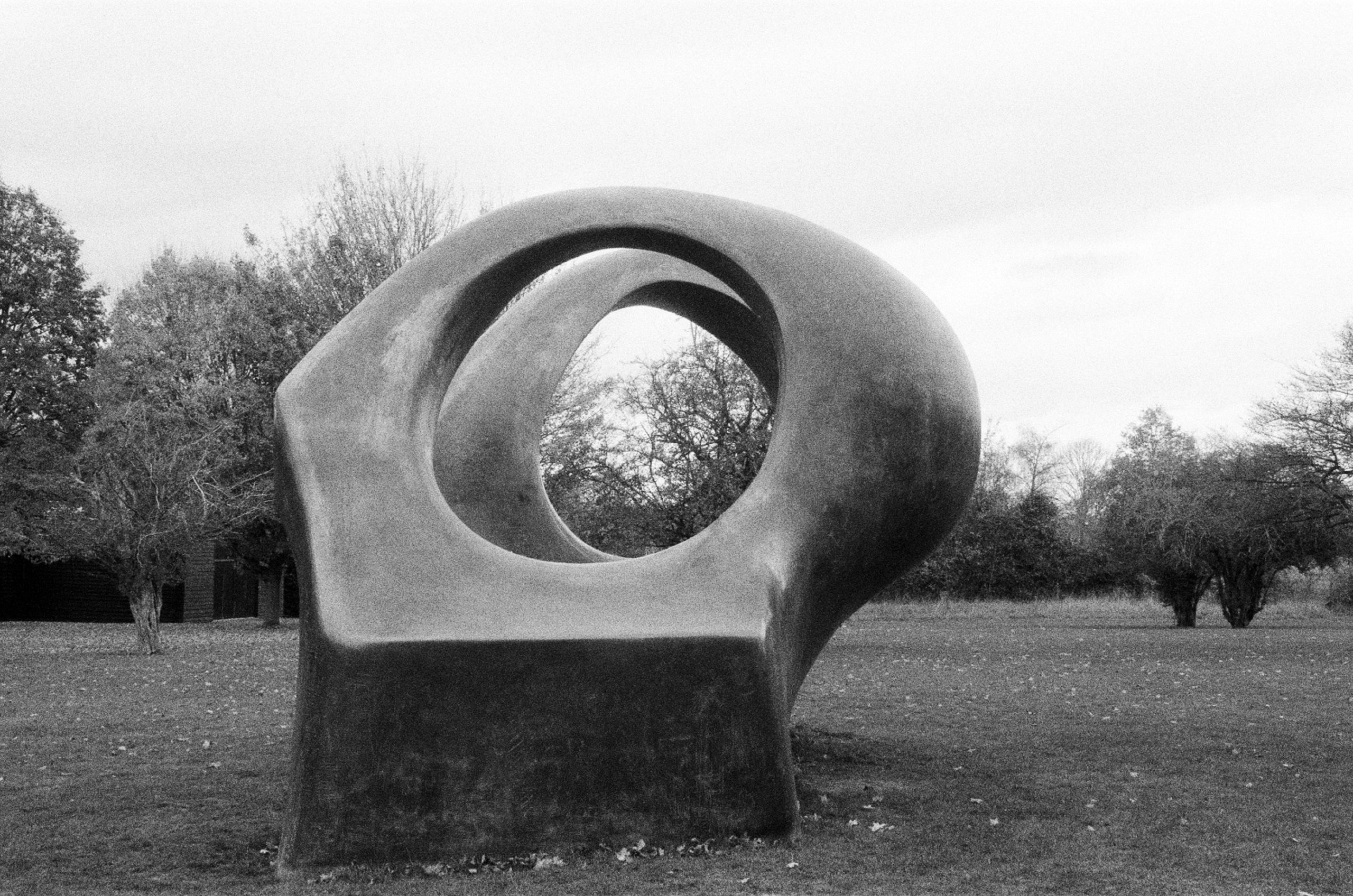
A piece of stone can have a hole through it and not be weakened—if the hole is of a studied size, shape and direction. On the principle of the arch, it can remain just as strong.
The first hole made through a piece of stone is a revelation.
The hole connects one side to the other, making it immediately more three-dimensional.
A hole can itself have as much shape-meaning as a solid mass.
Sculpture in air is possible, where the stone contains only the hole, which is the intended and considered form.
—Henry Moore, ‘The Sculptor Speaks’, Listener, August 1937
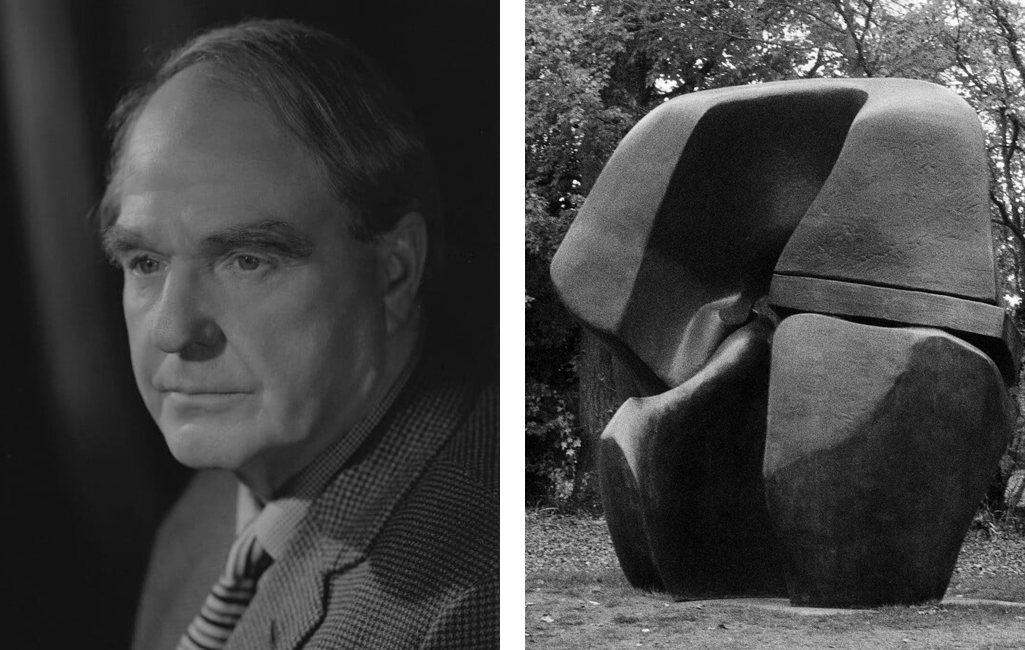
It is said that there are essentially four paths to self-transcendence: the ways of knowledge, surrender, service and beauty. Although one would not necessarily use the term beautiful in relation to Moore’s sculptures, one would agree they possess a visual vitality, similarly transporting the spectator to an unbounded sense of themselves. Over the course of his career, Moore returned to recurrent themes in his work that precipitated such feelings of awe and wonderment—mother and child, upright “motives”, the reclining figure—utilizing the power of holes and negative space as the threshold to a revelatory dimension beyond.
Indeed, by combining his academic training both at the Leeds School of Art (1919–21) and then later at the Royal College of Art in London (1921–24) with his passion for non-Western sculpture, Moore created his own distinctive style that became the symbol for all that was the epitome of modernity and abstraction in a society becoming increasingly avant-garde. Although he never explicitly aligned himself with any Eastern doctrines that explored nondual metaphysics, his work embodies an acute understanding of the interplay of elemental opposites—figure and landscape, parent and progeny, mass and void—so much so that by the end of his life, Moore was exploring psychological and even spiritual perspectives as he embraced the ideas of Post Formalism into his work.
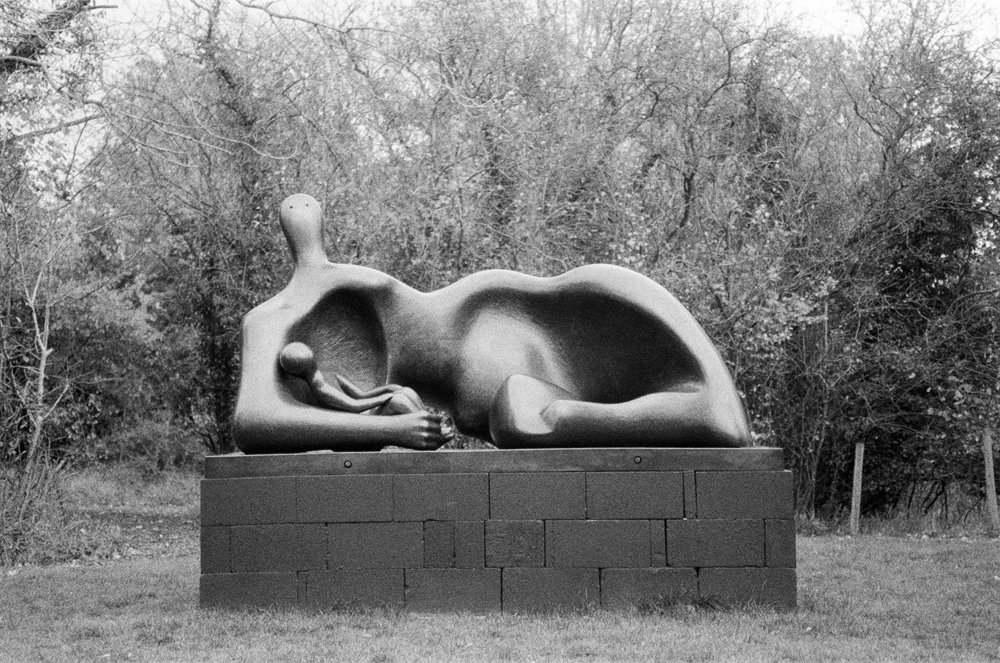
Irina Moore was also instrumental in creating the Perry Green paradisal haven by keeping the garden beds close to the house abundant with bright blooming flowers: poppies, red hot pokers, foxgloves and Michaelmas daisies, which were often cut and placed in vases throughout the house. Together with the verdant fields of grass lined with minimal trees and mantled by the vast wide space of the English skyline, Hoglands was the ideal outdoor gallery for her husband’s sculpture both in terms of each piece’s singularity and its relationship with the natural world.
Interestingly, his pièce de résistance, Large Reclining Figure (1984), which famously sits atop a small hill some four hundred yards away from the main house was never actually seen in situ in Moore’s lifetime, being the realization of an idea he had had more than four decades earlier, when he photographed the original lead maquette against the landscape, bringing it close to the camera so that it appeared colossal in relation to the view. At over nine metres long and weighing four tonnes, the final work is his largest to be cast in bronze. Sadly, on the day of my visit, the pathway leading from the back of Sheep Field Barn to the sculpture itself was closed and the lens of my vintage Nikon FM2 film camera could not do it any justice. So you must take my word for it. Large Reclining Figure is utterly magnificent.
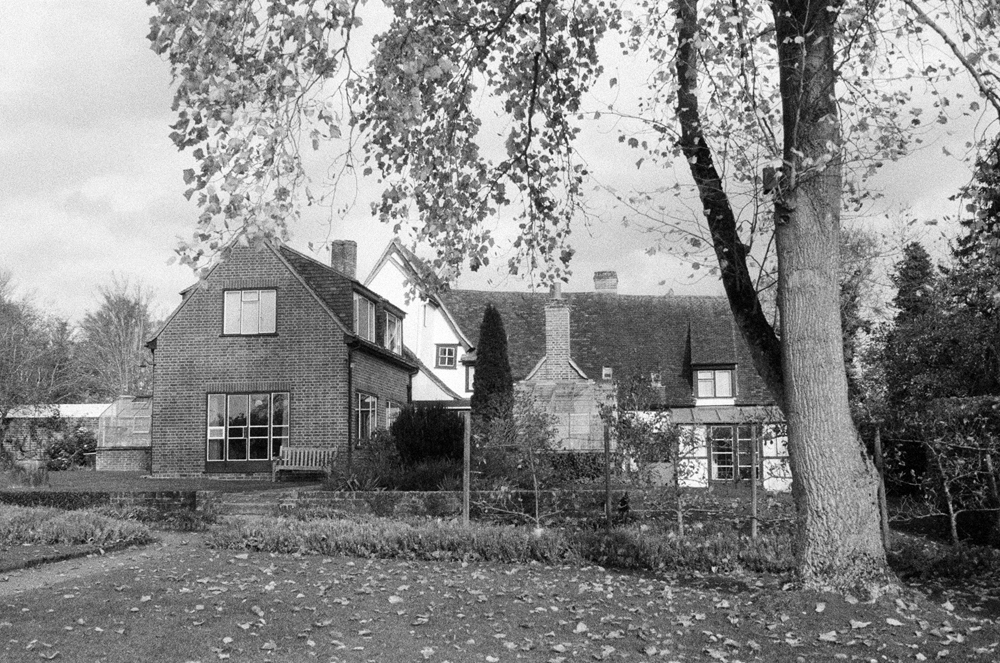
It might seem from what I have said of shape and form that I regard them as ends in themselves. Far from it. I am very much aware that associational psychological factors play a large part in sculpture. The meaning and significance of form itself probably depends on the countless associations of man’s history. For example, rounded forms convey an idea of fruitfulness, maturity, probably because the earth, women’s breasts, and most fruits are rounded, and these shapes are important because they have this background in our habits of perception. I think the humanist organic element will always be for me of fundamental importance in sculpture, giving sculpture its vitality. Each particular carving I make takes on in my mind a human, or occasionally animal, character and personality, and this personality controls its design and formal qualities, and makes me satisfied or dissatisfied with the work as it develops.
My own aim and direction seems to be consistent with these beliefs, though it does not depend upon them. My sculpture is becoming less representational, less an outward visual copy, and so what some people would call more abstract; but only because I believe that in this way I can present the human psychological content of my work with the greatest directness and intensity.
—Henry Moore, ‘The Sculptor Speaks’, Listener, August 1937
Writers & Artists Spirituality Series
Post Notes
- All images: © Paula Marvelly, Double Oval, Hoglands, Three Piece Sculpture: Vertebrae, Knife Edge Two Piece, Locking Piece, Draped Reclining Mother and Baby, Hoglands, Double Oval, except Walter Bird, Henry Moore, bromide print, 26 November 1963, © National Portrait Gallery, London, CC BY-NC-ND 3.0, Attribution-NonCommercial-NoDerivs 3.0 Unported [slightly cropped]
- Henry Moore, “The Sculptor Speaks”, in Listener, 18 August 1937, pp.338–40, in Henry Moore: Sculptural Process and Public Identity, Tate Research Publication, 2015, accessed 19 April 2026
- Henry Moore Studios & Gardens
- Writers & Artists Spirituality Series
- Jeremy Moulsdale: Contemporary Sculpture Artist
- Anna Gillespie: Give Me Shelter
- Antony Gormley: Sculpted Space Within and Without
- Hannah Peschar Sculpture Garden & Zen Master Ryokan
- Sidi Larbi Cherkaoui & Antony Gormley: Sutra
- Paolo Sorrentino: The Great Beauty
- Wassily Kandinsky: Concerning the Spiritual in Art
- Bill Viola & Michelangelo: Life Death Rebirth
- Armen Agop: Contemporary Spiritual Art
- Henry David Thoreau: Walking
- The Culturium uses affiliate marketing links via the Amazon Associates Programme