The triumph of nature
Before the swallow, before the daffodil, and not much later than the snowdrop, the common toad salutes the coming of spring after his own fashion, which is to emerge from a hole in the ground, where he has lain buried since the previous autumn, and crawl as rapidly as possible towards the nearest suitable patch of water …
ERIC ARTHUR BLAIR, better know as George Orwell (25th June 1903–21st January 1950), was not a metaphysical writer in the strictest sense (he was in fact an atheist) but he did have an acute understanding of how words and language create our perception of the world, immortalized in his pièce de résistance novel, 1984, and specifically the concept of doublethink.
For me, it is Orwell’s pithy essays that have the most profound appeal, with themes ranging between the six rules for writing good English in order to prevent linguistic manipulation (“Politics and the English Language”), a critique on religious asceticism and why sainthood is never a good idea (“Reflections on Gandhi”) and, one of my personal favourites, tips for making the perfect brew (“A Nice Cup of Tea”), although he makes the unforgivable error of saying that milk should only be added after the black tea is in the cup, when any tea aficionado will tell you it should be poured in first (or better still, in the case of drinking superior green tea, with no milk at all).
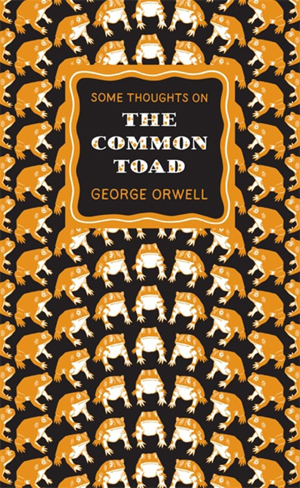
Another quintessential meditation on British culture is Orwell’s “Some Thoughts on the Common Toad”, first published in Tribune exactly 80 years ago today on Sunday 12th April 1946. On the surface, it is a modest seasonal essay, yet its core message points to how living in a modern, mechanized society so often distances us from the natural world and, ultimately, ourselves. Indeed, writing in the shadow of World War II, political propaganda and ideological rigidity, he turns to the emergence of a humble toad from hibernation as a metaphorical means of signalling how nature can become an emblem of innocent existence, akin to the “noble savage” of Jean-Jacques Rousseau.
The spring is commonly referred to as ‘a miracle’ and during the past five or six years this worn-out figure of speech has taken on a new lease of life. After the sort of winters we have had to endure recently, the spring does seem miraculous, because it has become gradually harder and harder to believe that it is actually going to happen. Every February since 1940 I have found myself thinking that this time Winter is going to be permanent. But Persephone, like the toads, always rises from the dead at about the same moment. Suddenly, towards the end of March, the miracle happens and the decaying slum in which I live is transfigured. Down in the square the sooty privets have turned bright green, the leaves are thickening on the chestnut trees, the daffodils are out, the wallflowers are budding, the policeman’s tunic looks positively a pleasant shade of blue, the fishmonger greets his customers with a smile, and even the sparrows are quite a different colour, having felt the balminess of the air and nerved themselves to take a bath, their first since last September.
Despite its miraculous composition, what is striking about Orwell’s reflections is his refusal to romanticize. Taking his own advice that “good prose is like a window pane”, even the most ordinary urban London landscape comprising the Deptford gasworks and the Bank of England carry their own quiet dignity by the simple fact of being noticed when they are touched by the hand of spring. Orwell’s clarity lies in his ability to remain with what is witnessed, without imposing lofty sentiment. In so doing, he reveals how much of our suffering and estrangement from life is ultimately self-imposed.
There is, beneath the writing, a subtle ethical position. To pay attention to the toad is to step outside the endless churn of opinion and anxiety, the bane of modern civilization, if only for a moment. Paradoxically, It is not an escape from reality but a return to the isness of life. Orwell also seems to suggest that sanity depends not on solving the world’s problems in their entirety but on maintaining a thread of contact with what simply exists in the here and now. Indeed, truly observing the toad reveals a remarkable creature blessed with the most beautiful features, with eyes “like gold, or more exactly … the golden-coloured semi-precious stone which one sees in signet-rings, and which I think is called chrysoberyl.” Quite the opposite, we discover, of its ugly and repulsive reputation.
Sadly, the work of George Orwell has gone somewhat out of fashion these days, replaced by the relentless tirades of Substackers peddling their ideological positions in a world gone increasingly mad. On the 80th anniversary of the publication of such an esteemed meditation, thank God for a political thinker whose ideas resonate now more than ever before.
… spring is here, even in London N.1, and they can’t stop you enjoying it. This is a satisfying reflection. How many a time have I stood watching the toads mating, or a pair of hares having a boxing match in the young corn, and thought of all the important persons who would stop me enjoying this if they could. But luckily they can’t. So long as you are not actually ill, hungry, frightened or immured in a prison or a holiday camp, Spring is still Spring. The atom bombs are piling up in the factories, the police are prowling through the cities, the lies are streaming from the loudspeakers, but the earth is still going round the sun, and neither the dictators nor the bureaucrats, deeply as they disapprove of the process, are able to prevent it.
Post Notes
- Images: © Paula Marvelly, Charleston
- The Orwell Foundation
- Ralph Waldo Emerson: Nature
- Ralph Waldo Emerson: Waldeinsamkeit
- Henry David Thoreau: Walking
- Robert Louis Stevenson: An Apology for Idlers
- John Ruskin: On Art and Life
- Rousseau: Meditations of a Solitary Walker
- Andrew Marvell: On a Drop of Dew
- Percy Bysshe Shelley: The Cloud
- The Culturium uses affiliate marketing links via the Amazon Associates Programme